AskUIT AI Academic Assistant
An intelligent multi-agent chatbot combining hybrid retrieval RAG to assist students with university academic procedures and inquiries.
Encouragement Prize Winner at SEApp 2025







Overview
AskUIT AI Academic Assistant is an intelligent conversational agent engineered to answer student inquiries about academic rules, schedules, course registration, and administrative procedures at the University of Information Technology (UIT - VNUHCM).
By combining a Multi-Agent orchestration architecture with a Hybrid Search Retrieval-Augmented Generation (RAG) pipeline, AskUIT delivers accurate, context-grounded, and verifiable responses while minimizing hallucinations.
Demo Video
Project Poster
Explore the complete AskUIT project poster for an overview of its architecture, workflow, and technical implementation: view the project poster on Google Drive.
Key Features & Achievements
- Award-winning project: Awarded Encouragement Prize at SEApp 2025.
- Hybrid Search RAG: Merges dense vector embeddings with sparse keyword search (BM25) to accurately match Vietnamese academic terminology.
- Multi-Agent System: Routes queries to domain-specific agents (e.g., regulations, course metadata, schedules, general inquiry).
- Verifiable Sources: Links responses directly back to official university document sources and regulations.
Technical Architecture
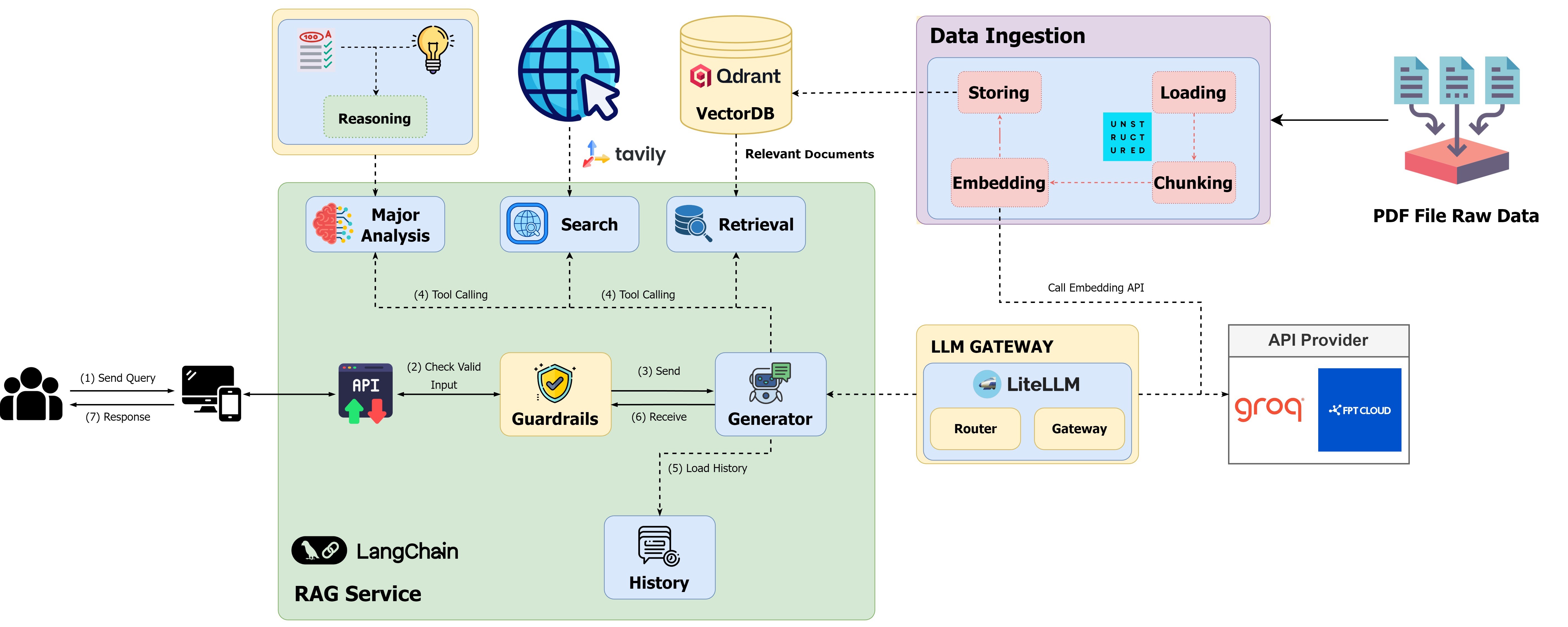
AskUIT follows an agentic RAG architecture composed of three main building blocks:
- RAG Service — Real-time query processing backend (FastAPI + LangChain) that orchestrates multi‑agent reasoning, tool calling, and response generation.
- Data Ingestion Pipeline — Offline pipeline that loads, chunks, embeds, and indexes academic PDF documents into a vector database for semantic retrieval.
- LLM Gateway & API Provider Layer — Abstraction layer (LiteLLM Router + Gateway) that normalizes and routes LLM/embedding requests to multiple inference providers (Groq, FPT Cloud) for resilience and model diversity.
Runtime Query Flow (RAG Service)
(1) Send Query        : User → API (FastAPI)
(2) Check Valid Input  : API → Guardrails (input validation & safety)
(3) Send                : Guardrails → Generator (LangChain Agent)
(4) Tool Calling        : Generator → [Major Analysis | Search | Retrieval]
(5) Load History         : Generator → History (conversation memory)
(6) Receive               : Generator → Guardrails (output validation & safety)
(7) Response               : API → User
Step‑by‑step:
- The user submits a query from the client (web/mobile) to the FastAPI endpoint.
- FastAPI validates the input and forwards it to Guardrails for safety checks (prompt injection, toxicity).
- Clean input reaches the Generator — a LangChain agent equipped with tool‑calling capabilities.
- The agent decides which tools to invoke:
- Major Analysis — internal reasoning module with evaluation checklist for deep query understanding.
- Search — calls Tavily API for up‑to‑date web information when internal knowledge is insufficient.
- Retrieval — queries Qdrant VectorDB for semantically relevant document chunks.
- In parallel, the agent loads conversation History to maintain multi‑turn context.
- The agent synthesizes tool results and calls an LLM via LiteLLM (routed to Groq or FPT Cloud) to produce the final answer, which passes back through Guardrails for output safety.
- FastAPI returns the validated response to the user.
Data Ingestion Workflow (Offline)
PDF Raw Data → Loading → Chunking → Embedding → Storing → Qdrant VectorDB
- Loading & Chunking:
Unstructuredextracts and splits PDF content into semantically coherent chunks. - Embedding: Each chunk is embedded via LiteLLM → API Provider (embedding models).
- Storing: Vectors + metadata are persisted in Qdrant for low‑latency semantic search at query time.
Tech Stack
| Component | Technology | Role |
|---|---|---|
| Backend API | FastAPI (Python) | High‑performance async REST API, auto OpenAPI docs, request validation |
| Orchestration Framework | LangChain | Agent framework, tool calling, memory management, RAG pipeline orchestration |
| Input/Output Safety | Guardrails | Input validation, output filtering, prompt‑injection & toxicity protection |
| Vector Database | Qdrant | High‑performance vector similarity search, metadata filtering, payload storage |
| Web Search Tool | Tavily API | Real‑time web search for factual grounding when internal KB is insufficient |
| Data Parsing / Chunking | Unstructured | PDF extraction, intelligent chunking, metadata preservation |
| LLM Gateway | LiteLLM (Router + Gateway) | Unified LLM/embedding interface, load‑balancing, fallback, provider abstraction |
| Inference Providers | Groq (LPU), FPT Cloud | High‑throughput LLM inference, model diversity, geo‑redundancy |
| Session Memory | Custom History Store | Conversation history per session for multi‑turn context |
| Reasoning Module | Major Analysis (checklist‑based) | Structured reasoning & insight generation for complex academic queries |
Related Links
- Research Focus: Multi-Agent Systems & RAG
- Institution: University of Information Technology (UIT - VNU-HCM)